Chapter 1 Investigation of the Root Causes of Earthquakes
The surface of the Earth is covered with thick bedrock called ‘plates’.The earth and sea we live in exist on this plate.
The plates are not a single large rock, they are divided into a dozen pieces on Earth, constantly moving at a very slow speed of a few centimeters per year.It’s a good idea.It is a slow movement that humans cannot experience, but it accumulates large amounts of energy over a long period of time.
Especially at the boundary where plates collide with each other, or where one subducts under the other, there is strong pressure.This pressure causes strain to accumulate in the bedrock, and an earthquake occurs by shifting at once at the moment when the limit is reached.
In addition, there are parts of the stratum called ‘faults’ that are prone to dislocation in the ground, and earthquakes can occur even if they move rapidly.Those that may be active in the future are called ‘active faults.’
If the shaking of an earthquake becomes large, it can lead to serious damage such as collapse of buildings, fire, and tsunami.
Map of earthquakes
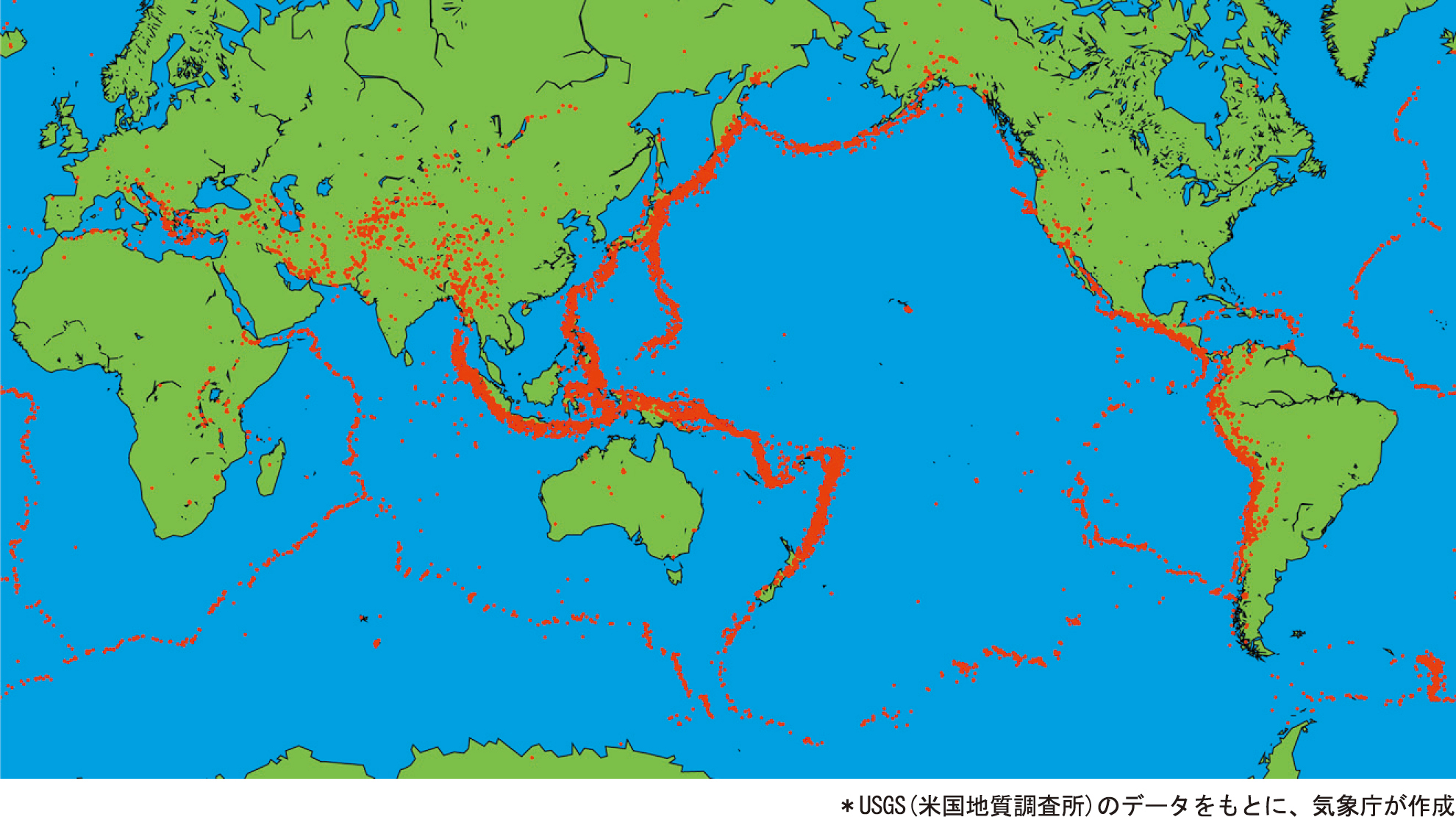
As shown in the figure, it occurs mainly in the coastal areas of the Pacific Ocean.
*Source: Earthquake Research Promotion Headquarters
Measurement of earthquakes
Measurement of earthquake strength
-Magnitude: Energy of an earthquake
Measurement method: Measuring using a seismometer.
Measurement of Earthquake shaking
– Japan Meteorological Agency Seismic Intensity class (10 levels)
Measurement method: It is measured with a thing called a measuring seismic intensity meter.In the past, the seismic intensity was determined by the shaking experienced by people.
-Revised Mercari Seismic intensity level (12 levels)
Measurement method: It is measured by the shaking experienced by people and the damage condition of the building.
※The measurement of the shaking of the earthquake varies depending on the country
※ Source: Japan Meteorological Agency Seismic intensity, magnitude, Earthquake information
※ Source: Disaster Prevention Science Research Institute Basic knowledge of earthquakes and earthquake information ※ Source: Japan Meteorological Agency Seismic intensity, magnitude, Earthquake information ※ Source: Japan Meteorological Agency Seismic intensity, magnitude, earthquake information ※ Source: Japan Meteorological Agency Seismic intensity, magnitude, earthquake information ※ Source: Japan Meteorological Agency Seismic intensity, magnitude, earthquake informationIts observations
Number of earthquakes in the world (M9 or higher)
| Location | Year of occurrence | Average year of occurrence interval |
|---|---|---|
| Off the Coast of Chile | 1960 | |
| Off Sumatra Island | 2004 | |
| Alaska off the Pacific Ocean | 1964 | |
| Off the Pacific Ocean in the Tohoku region | 869, 2011 | 1142 |
| Kamchaka Peninsula off the Pacific Ocean | 1952 |
Month of Earthquake Occurrence
Based on publicly available data from the U.S. Geological Survey, the monthly occurrence of earthquakes with a magnitude of 7 or greater worldwide between 1900 and 2026 has been calculated. ※ No significant monthly variation observed.
| Moon | Number of occurrences |
|---|---|
| 1 | 137 |
| 2 | 121 |
| 3 | 131 |
| 4 | 132 |
| 5 | 147 |
| 6 | 119 |
| 7 | 132 |
| 8 | 153 |
| 9 | 111 |
| 10 | 133 |
| 11 | 152 |
| 12 | 139 |
Chapter 2 Recommendations for Earthquake Countermeasures
Recommendations for Earthquake Countermeasures heard from Someone
[Individual] Action to protect life
Escape to a high place (Tsunami evacuation): Escape ‘immediately and high’ regardless of the magnitude of the shaking by the sea or near the riverIt is an iron rule.
Careful handling of fire: In the past, people were told to ‘put out the fire immediately’, but now ‘protect yourself first, check the fire after the shaking has subsided’ is the basic.Also, when evacuating, let’s drop the breaker to prevent energized fire.
Earthquake-resistant and fire-resistant: Your home’s earthquake-resistant diagnosis and your interest in flame-resistant building materials (fire-resistant structures) are the biggest investments to save lives.
Insurance (Earthquake insurance): The national and local governments’ support is not enough to rebuild their lives after a disaster.Insurance is an essential measure to ‘restore life’.
[Society/ Company] A system that does not stop business and life
BCP (Business Continuity Plan): It is a plan that does not stop business even if a company is damaged.The more firm the company is, the faster the recovery of society will be.
Remote backup: By storing data in a physically remote location (cloud, etc.), you can protect important records even if your office is damaged.
Early warning system: It is the use of the latest technology such as earthquake early warning, to stop the machine and protect yourself a few seconds to tens of seconds before the shaking comes.
Breakwaters: Measures as infrastructure.It is also a good measure to know how your city is protected by a local hazard map.
[Mutual Support] A system to help the affected areas
Fund・raising: Directly support the reconstruction of the lives of the victims.
Blood donation: Immediately after an earthquake, blood tends to be scarce due to an increase in injuries and disruption of transportation networks.’Being in a healthy body in advance’ is also a good preparation.