Chapter 1: Investigating the Root Causes of Climate Change
Climate change is a long-term phenomenon in which the Earth’s climate, including global temperatures, rainfall, and wind patterns, changes. In recent years, the effects of global warming have led to more frequent extreme weather events, such as heatwaves and heavy rainfall, which have become major problems. One of the main drivers of climate change is the increase in carbon dioxide (CO2) and other greenhouse gases produced by burning fossil fuels such as coal and oil. These gases accumulate in the atmosphere and trap heat, making it harder for the Earth to release it into space. As economic activity grows, energy consumption rises, leading to higher CO2 emissions. However, economic growth is also essential for improving living standards and advancing society. Therefore, achieving sustainable economic growth while protecting the environment has become a major challenge in contemporary society.
Climate Change Panel
| 22nd century | 21st century | 20th century | |
|---|---|---|---|
| Temperature | right here. | About +0.6 | |
| Sea level | APPROXIMATELY +17CM | ||
| Remarks | Warm season | Warm season | |
| 19th century | 18th century | 17th century | |
| Temperature | |||
| Sea level | |||
| Remarks | Small Ice Age Industrial Revolution | Small Ice age | |
| 16th century | 10th-15th centuries | 1-10th century | |
| Temperature | |||
| Sea level | |||
| Remarks | Small Ice age | Medieval temperate period |
Measuring the climate
– Milanković Cycle
The theory that the distance between the Earth and the Sun and the inclination of the Earth’s rotation regularly affect the climate
Cycle
| start. | Distance between Earth and Sun | Remarks | |
|---|---|---|---|
| Glacial period | Undecided | ||
| Interglacial period | About 1 million years ago B.C. * In the present interglacial period | close. | |
| Glacial period | (At least) About 7 million years ago BC ~ | On the bottom of Lake Suigetsu, there was only a record until about 7 million years BC, and there was no record at the beginning of the glacial period | |
| Interglacial period | |||
| Glacial period | |||
| Interglacial period |
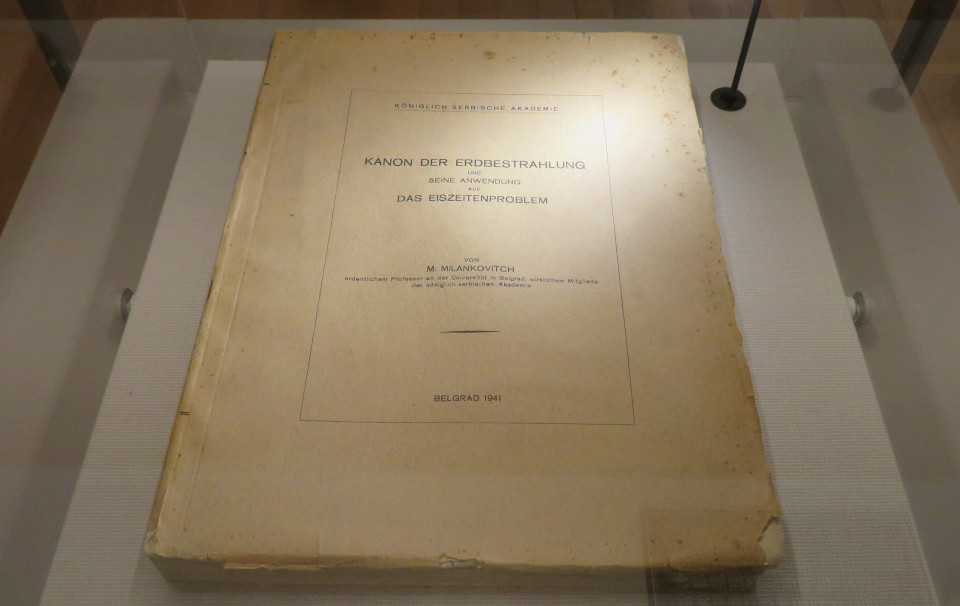
*A book that contains the formula of the Milankovic cycle.It is written in German, and it is assumed that it will take about 1 year to decipher it.
「kanon der erdbestrahlung」
「seine anwendling auf das eiszeitenproblem」
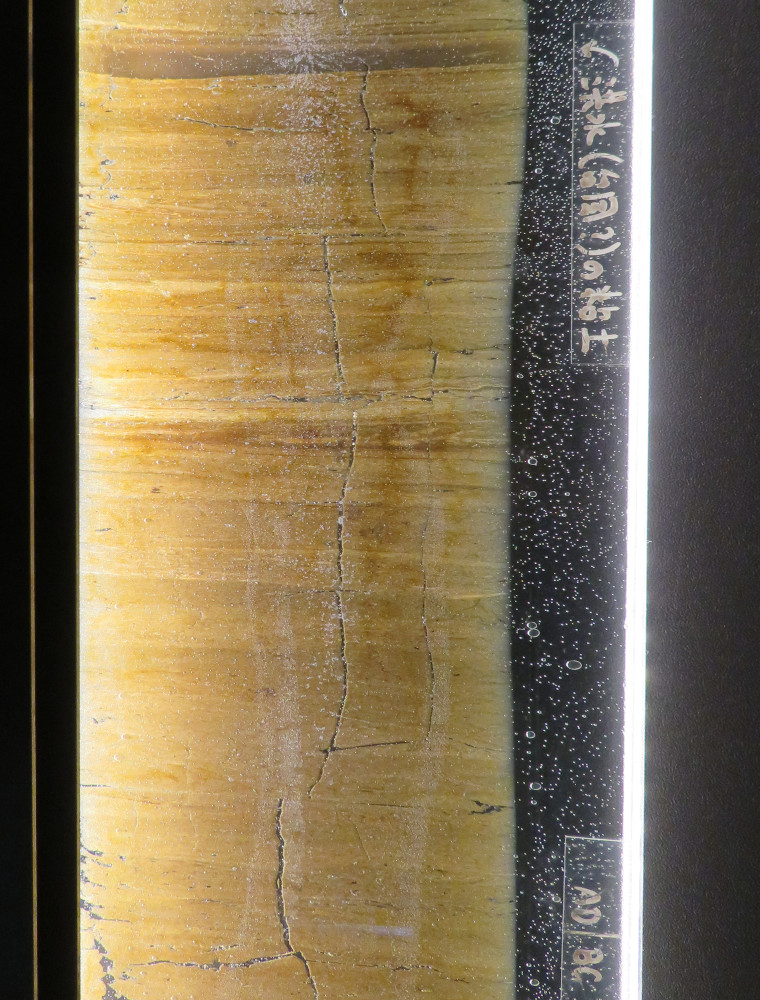
-Suigetsu Lake Sediments The bottom of Suigetsu
Lake has 1 pattern in 1 year and a pattern of about 7 million years (about 7 million times) remains.
It is said that dinosaurs went extinct about 6600 million years ago, and the present human race was born 25 million years ago.
It is said that 7 million years ago, the rapid cooling of the climate began by a volcanic explosion, and the current human race (Homo Sapiens) is on the verge of extinctionIt’s a good idea.
Image in the lake
|Lake Water |
| ——– |
| 1 year’s worth of sediment |
| ——– |
| 1 year worth of sediments |
———
Sediments at the bottom of the lake 7 millionIt is a state that has accumulated year by year.By analyzing sediments, it is possible to understand the climate.
↓The part of AC/DC at the bottom of the sediment (year stripe) is the part of 0 BC
Radioisotope Measurement
The half-life of radioactive carbon-14 contained in a substance is 5,730 years. By measuring the amount of carbon-14 in a material, it is possible to estimate how long ago that material was formed.
Ice Sheets
Ice sheets also have annual layers, and these layers can be used to infer past climate conditions.
Chapter 2. Recommendations for Climate Change Measures
Examples:
・3R products gradual spread: recycled products / used products / repair products
・Gradual spread of high-fuel-efficiency vehicles, hybrid vehicles, and electric vehicles
・Increase in the power conversion efficiency of energy sources
・Gradual spread of renewable energy such as solar power, hydroelectric power, and wind power
・Gradual spread of biofuels and bioplastics
・Energy-saving products
・Smart grid (next-generation power transmission network)
Power generation kinds of images
| Types | Power generation | Timing | Fuel | Application | Disadvantages | Year of development |
|---|---|---|---|---|---|---|
| Human power | Small | Fluctuations | – | Bicycle Lights | – | |
| Firepower | Large | always. | ○ | Electrical products | Climate change | Late 19th century |
| Hydraulic power | Large | always. | ‐ | Electrical products | Late 19th century | |
| Nuclear power | Large | always. | ○ | Electrical products | Radioactive material | Late 20th century |
| Geothermal energy | Large | always. | – | Electrical products | Early 20th century | |
| Biomass | Large | always. | ○ | Electrical products | Late 19th century | |
| Yangshui Hydropower | Large | Fluctuations | – | Energy storage | Late 19th century | |
| Wind power | Small | Fluctuations | – | Electrical products | Late 19th century | |
| Sunlight | Small | Fluctuations | – | Electrical products | Late 20th century | |
| Sound power | Small | Fluctuations | – | mike. | Late 19th century | |
| Vibration | Small | Fluctuations | – | Remote control | Early 21st century | |
| Space solar | Small | always. | – | Satellite | Late 20th century | |
| Under development | 21st century |
Remarks
Recommended Learning Materials
①Climate Station
A climate change learning software (PS5) jointly developed with the United Nations.
I think that you will acquire basic knowledge of climate change just by looking at the video library.
New energy individual verification
Verification:
Try using a mobile battery with solar panels Can I use it in an emergency? Whether it is possible
Result:
Even after 1 month, it will not be fully charged.If this goes on, it may take six months for the mobile battery to be charged with the solar panel.
I wanted to verify it with a medium-sized solar panel, but it seems that there is not yet a medium-sized solar panel for mobile batteries for rain prevention.
*Vibration power generation and semiconductor power generation will be verified at a later date